Accountability Isn’t a Process Problem. It’s a Relationship Failure.
Accountability Isn’t a Process Problem. It’s a Relationship Failure.
I spoke with a client yesterday who, discreetly, shared his frustration with the perception that his organization isn’t holding key business unit, functional, and geographic leaders accountable for their commitments to show up, be engaged, and benefit from the company’s investment in their personal and professional growth journeys. We’ve designed a world-class, year-long global leadership development program together with a significant investment of time, effort, and resources. Senior executives from every global theater were involved as crucial stakeholders, and their unique perspectives and demands were carefully integrated into the final development roadmap, which includes a “certification” at the end. This certification will significantly enhance, if not elevate, their thinking, personal and professional growth, and individual leadership market value.
This morning, I read Gallup’s latest research, which offers a sobering yet unsurprising insight: accountability remains one of leadership’s biggest weaknesses. Not strategy. Not innovation. Not even execution. Accountability. Let that sink in.
In a world fixated on dashboards, KPIs, and performance management systems, the most stubborn leadership gap isn’t structural—it’s behavioral. And more specifically, it’s relational. Because accountability doesn’t reside in systems. It exists between people.
The Illusion of Accountability
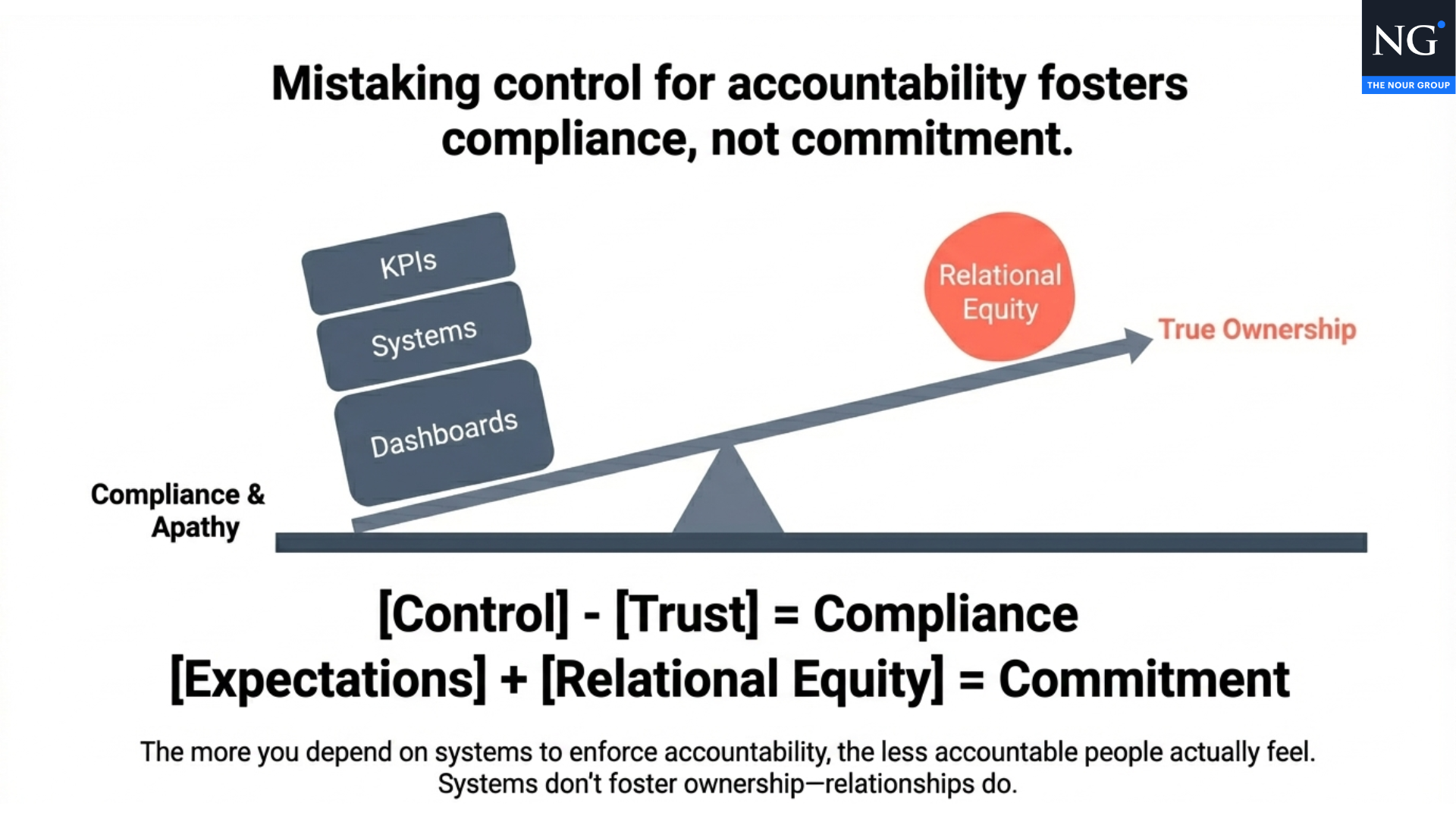
Most organizations view accountability as a compliance task with clear goals, specific metrics, regular checks, and penalties for poor performance. On paper, it seems foolproof. In reality, it often fails. Why? Because accountability is frequently mistaken for control. And control, without trust, fosters compliance rather than commitment.
Gallup’s extensive research reinforces this: the quality of managers and team leaders is the most important predictor of organizational performance. Translation: accountability doesn’t break down because of poor systems. It fails due to weak leadership relationships.
Relationship Economics of Accountability
In Relationship Economics, I’ve long maintained that relationships are not just soft skills—they are strategic assets and essential skills. Accountability clearly illustrates this principle. You can't hold someone accountable without relational equity. Relational equity, like trust, credibility, and mutual respect, is the currency that sustains accountability. Without it, feedback feels like criticism, expectations feel like pressure, and consequences seem like punishment. With it, feedback becomes valuable coaching, expectations are shared commitments, and consequences serve as opportunities for learning.
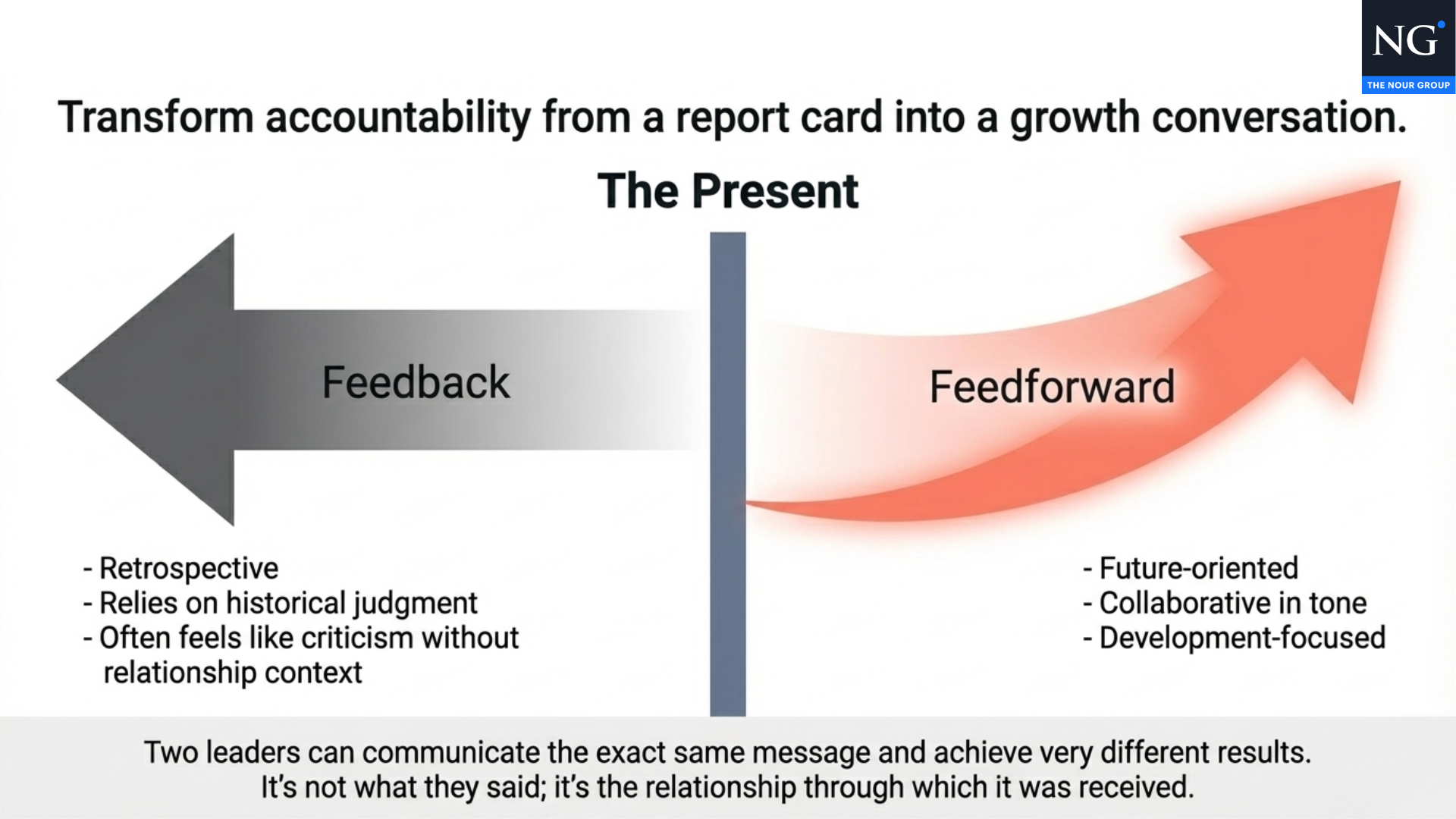
This is why two leaders can communicate the same message and yet achieve very different results. It’s not what they said; it’s the relationship through which it was received.
The Accountability Paradox
Here’s the paradox Gallup is pointing out, even if indirectly: The more you depend on systems to enforce accountability, the less accountable people actually feel. From my experience, systems don’t foster ownership—relationships do. Ownership happens when individuals feel recognized, valued, and connected to the goals. And none of that can be captured in a spreadsheet.
Gallup’s strengths-based leadership research highlights four key areas of effective leadership: executing, influencing, relationship building, and strategic thinking. Notice what’s often overlooked in accountability conversations: relationship building. Yet it is precisely this area that drives trust in expectations, openness to feedback, and the willingness to take responsibility for one’s actions (or lack thereof!). In other words, accountability stems from relationships.
Cultural Transformation Starts with Relational Clarity
If accountability is a cultural goal, then relationships are the foundation. Most companies try to “install” accountability without improving that foundation. That’s like running AI software on a 1998 laptop. Four key points, based on Relationship Economics, that might be useful for how you lead:
1. From Expectations to Agreements
Leaders often set expectations. High-accountability cultures co-create agreements. There’s a subtle but powerful difference. Expectations are imposed. Agreements are owned. Ask yourself:
Did I tell them what success looks like?
Or did we align on what success means?
Accountability thrives in alignment—not assumption.
2. From Feedback to Feedforward
Traditional accountability relies on retrospective feedback. But feedback without relationship context often feels like judgment. I learned from Marshall Goldsmith years ago, that high-performing leaders shift to feedforward:
Future-oriented
Development-focused
Collaborative in tone
This transforms accountability from a report card into a growth conversation.
3. From Individual Blame to Network Visibility
Here’s where most leaders miss the bigger picture. Accountability is rarely an individual failure. It’s often a network failure.
Who didn’t communicate upstream?
Where did the information stall?
Which relationships weren’t leveraged?
Gallup highlights invisible gaps in how work gets done. These gaps are almost always related to relationships. In my work with global clients, we call this relationship leakage—missed connections that quietly weaken performance. Accountability, then, isn’t just about “who owns this?” it’s about “who needed to be in the loop—and wasn’t?”
4. From Performance Management to Relationship Management
Most organizations invest heavily in performance systems, but few dedicate equal effort to relationship intelligence. Employees who feel their strengths are recognized and utilized are much more engaged. Engagement fosters ownership, and ownership leads to accountability. Instead of asking “Did we measure performance correctly?” consider asking a better question: “Did we understand and activate the right relationships to enable performance?” That’s a much different conversation.
The Leader’s Role: Architect of Accountability Ecosystems
Accountability doesn’t exist in isolation. It stems from an ecosystem that leaders intentionally or unintentionally build. This ecosystem includes psychological safety, clear roles and responsibilities, strength-based alignment, and strong relationship bonds. Great leaders don’t just enforce accountability; they create environments where accountability naturally occurs.
They invest in understanding their people, build trust before it's needed, promote visibility across departments, and normalize difficult conversations. And perhaps most importantly, they demonstrate it. Because the quickest way to weaken accountability is through inconsistent leadership.
A Practical Diagnostic
If you’re in the privileged role to lead others, here’s a simple but revealing exercise:
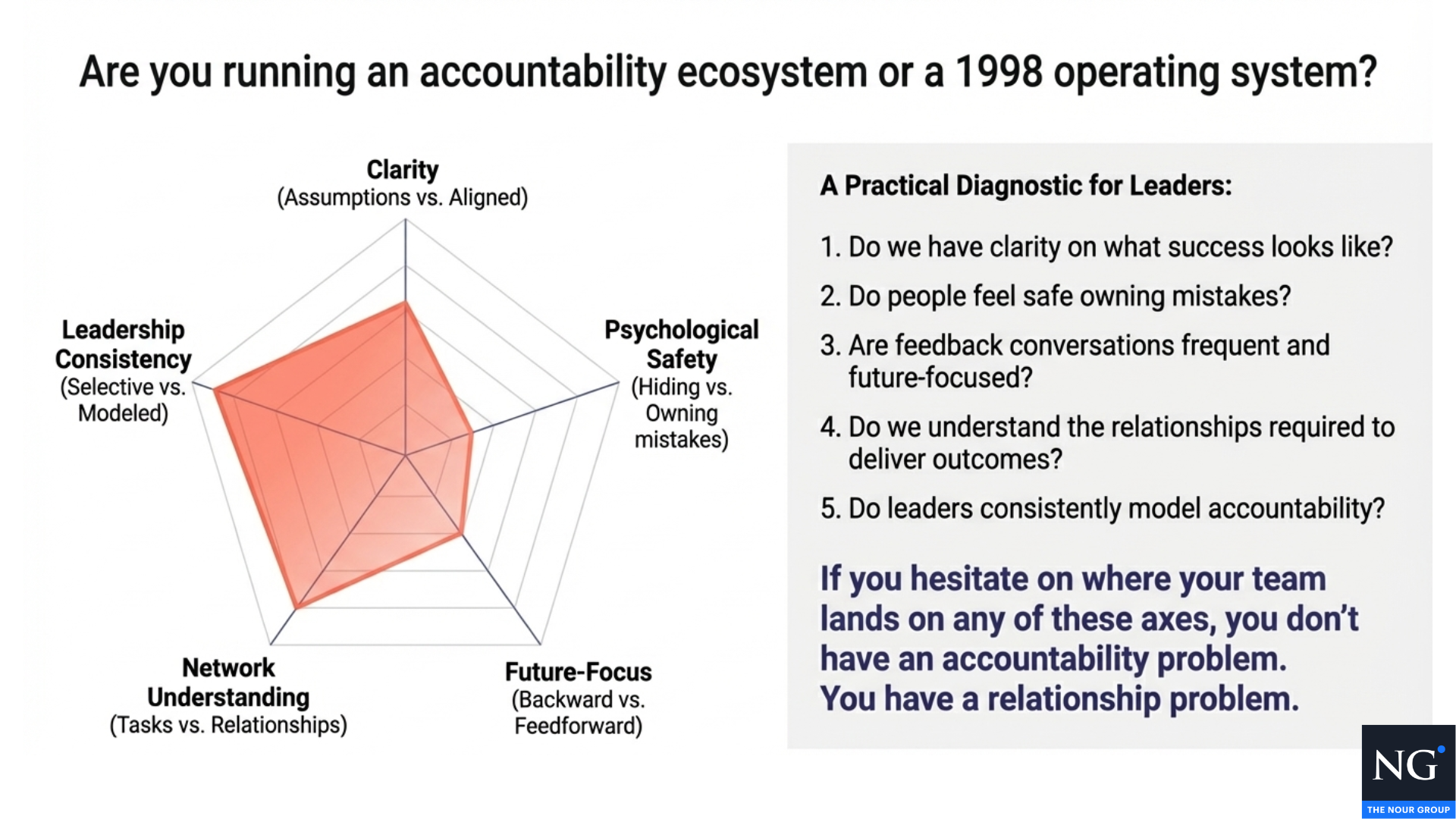
Ask yourself—and your team—these five questions:
Do we have clarity on what success looks like, or are we operating on assumptions?
Do people feel safe owning mistakes, or do they hide them?
Are feedback conversations frequent and future-focused, or episodic and backward-looking?
Do we understand the relationships required to deliver outcomes, or just the tasks?
Do leaders consistently model accountability, or selectively enforce it?
If you hesitate on any of these, you don’t have an accountability problem. You have a relationship problem.
The Strategic Value of Accountability (Done Right)
When accountability is grounded in strong relationships, it becomes a strategic advantage:
Faster decision-making (because trust reduces friction)
Higher win rates (because alignment improves execution)
Stronger culture (because ownership becomes shared)
Better retention (because people feel valued, not managed)
In a world where competitive differentiation is rare, how your organization collaborates becomes the key advantage. And true accountability is the proof point.
Final Thought: Accountability Often Starts in the Mirror
Accountability doesn’t expose employee weaknesses; it highlights leadership effectiveness. If your team isn’t accountable, consider the clarity you’ve provided, the trust you’ve established, and the relationships you’ve built. Because at its core, accountability isn’t about holding people responsible; it’s about creating relationships where responsibility is voluntarily embraced. That’s the shift Gallup is emphasizing.
And for those willing to embrace it, it’s not just a cultural upgrade; it’s a strategic transformation.
