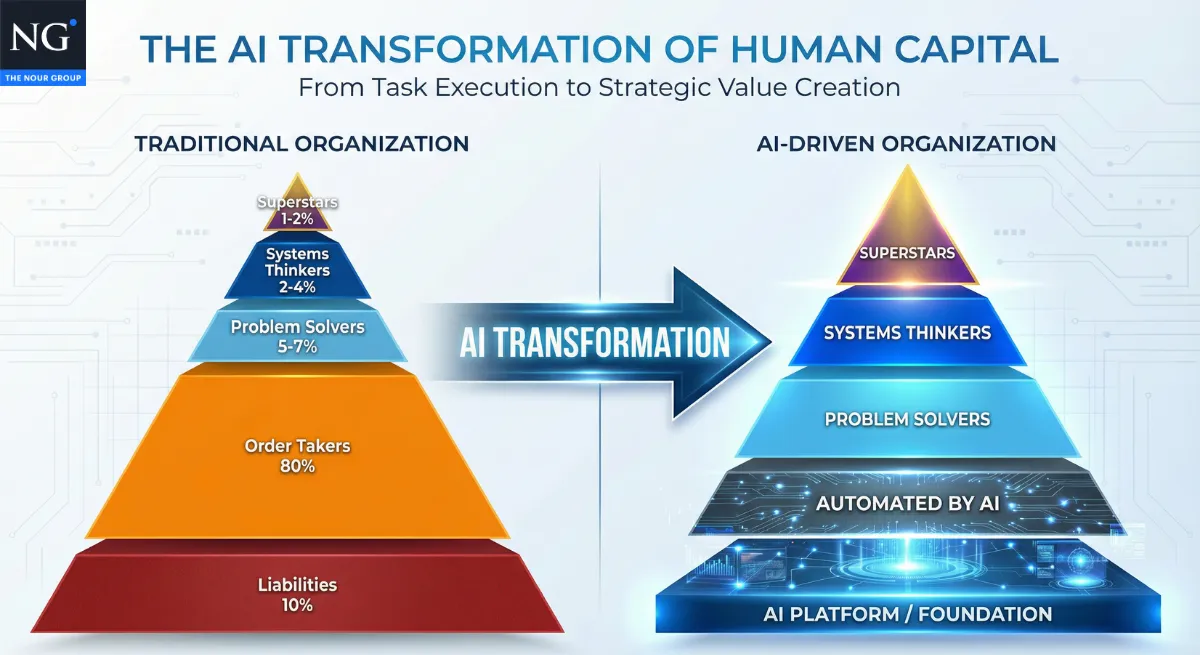
Human Capital Pyramid
In an AI-Driven World, Relationship-Centric Organizations Outperform—and Why Leaders Must Respond Now
Every organization, regardless of industry or geography, eventually confronts the same uncomfortable truth: talent, effort, judgment, curiosity, and the ability to see around corners are not evenly distributed.
Over the years—through my work on Relationship Economics®, Co-Create, and Curve Benders—I’ve observed a consistent pattern across high-performing and struggling organizations alike. It’s not a hierarchy of titles. It’s a hierarchy of material contribution. And it looks remarkably like a human capital pyramid.
Understanding this pyramid isn’t about labeling people. It’s about making better leadership decisions, designing healthier relationship ecosystems, and intentionally moving value creation up the stack. Leaders who ignore it default to mediocrity. Leaders who manage it thoughtfully bend performance curves and amplify meritocracy. Here is what the pyramid looks like, and more importantly, its implications for your organization:
At the Base: Liabilities Drain Relationship Capital
Every organization has them. Individuals who, regardless of role, increase friction, consume disproportionate attention, and create downstream consequences that others must clean up. They miss deadlines, erode trust, and require constant supervision. Not because they’re malicious—but because they lack alignment, competence, or accountability. In most organizations, this group represents roughly 10%.
From a Relationship Economics perspective, liabilities destroy relationship ROI. They erode trust faster than they create value. Worse, their impact is rarely isolated. Research from MIT Sloan shows that low performers increase coordination costs across teams by as much as 40%. That’s not just an HR issue—it’s an enterprise drag.
The leadership mistake here is tolerance, often because these are “nice people!” When leaders allow liabilities to persist, they send a message about acceptable behavior and dilute their credibility. As we know, culture is not what you say—it’s the culmination of the behaviors you are willing to tolerate!
The Middle Majority: Order Takers Sustain—but Don’t Scale
The largest segment of the pyramid—often close to 80% of the people in many organizations—is made up of order takers. These individuals show up, follow instructions, and complete assigned tasks. They’re dependable. They’re necessary. And they’re rarely transformative.
Order takers are not the problem. Over-reliance on them is.
They operate with a highly transactional mindset: “Tell me what to do, and I’ll do it.” Or worse, “You never told me not to do that!” There’s little curiosity about why, little ownership of outcomes, and minimal anticipation. They keep the lights on—but they don’t redesign the grid.
In Co-Create, I argue that sustainable growth requires shifting from execution-only relationships to shared problem framing. Order takers execute someone else’s agenda. They don’t help shape it. In a world defined by complexity and speed, that limitation becomes evident quickly.
Problem Solvers: The First Inflection Point
Then there’s a sharp drop-off in volume—and a sharp rise in value. Roughly 5–7% of people in many organizations are natural problem solvers. They don’t wait to be told. They see issues, identify gaps, and propose solutions. They act with initiative, not instruction.
What they often lack isn’t capability—it’s access to decision-makers, resources, and political capital.
This is where relationship leverage becomes critical. Problem solvers create value when leaders remove friction and connect them across silos. When ignored, they disengage. When empowered, they become catalysts.
Organizations that fail to recognize this group often lose them—not to competitors, but to indifference.
Systems Thinkers: Where Performance Compounds

At the next tier—typically 2–4% of the organization—are systems thinkers. These are the individuals who understand that no decision exists in isolation. They see interdependencies. They anticipate second- and third-order effects. They know how to influence without authority and align stakeholders with competing incentives.
Systems thinkers don’t just solve problems. They redesign the system that created the problem, in essence, solving for the root cause and not the symptoms!
In Curve Benders, I describe these individuals as inflection-point navigators. They recognize when incremental improvement is insufficient and when a fundamental shift is required. They operate with contextual intelligence—understanding not only what to do but also when and with whom.
These are your consistent high performers, not because they work harder—but because they work smarter across relationships.
At the Apex: Superstars Exponentially Multiply Enterprise Value Creation
At the very top—often less than 1–2% of your people—are true superstars.
These individuals combine performance and potential. They anticipate needs before they’re articulated. They are driven by intellectual curiosity. They think in terms of options, not answers. And they represent your organization with a level of credibility that no brand campaign can match.
Superstars are not merely 10x talent. They are force multipliers.
What distinguishes them most is solution optionality—the ability to see multiple viable paths forward and choose the one that optimizes long-term value rather than short-term gain. They don’t just respond to problems; they reframe them.
From a Relationship Economics perspective, superstars generate disproportionate returns on relationship investments. They attract other exceptional talent. They retain intelligent and profitable clients. They influence ecosystems beyond organizational boundaries.
They are rarely motivated by compensation alone.
The Leadership Question Isn’t Talent—It’s Flow
Here’s the critical insight most leaders miss: the pyramid is not fixed. People can move, but not without intentional leadership.
Organizations that outperform don’t just hire better—they design environments that foster upward movement. They reduce friction for problem solvers. They amplify systems thinkers. They protect superstars from bureaucracy and burnout. And they decisively address liabilities.
This requires shifting from a management mindset to a relationship-centric operating model.
In Co-Create, I emphasize that value is no longer created in silos—it’s co-created across networks. Leaders must act as connectors, not controllers. They must invest relationship capital where it compounds most.
Practical Implications for Leaders

Audit Material Contribution, Not Titles
Stop assuming seniority equals value. Assess who actually moves strategic outcomes forward—especially across functions.Promote Agenda Setters, Not Just Executors
Reward those who frame problems, not just those who complete tasks.Design for Cross-Pollination
Systems thinkers thrive when exposed to diverse perspectives. Create intentional collisions.Have the Courage to Act on Liabilities
Compassion is not avoidance. Addressing underperformance is a leadership responsibility.Protect Your Apex
Superstars don’t need more rules. They need clarity, autonomy, and trust.
The Curve-Bending Opportunity
Most organizations focus their energy on managing the middle. High-performing organizations invest disproportionate effort in enabling the top and elevating the capable. The difference is not headcount. It’s intentionality.
When leaders understand the human capital pyramid—and manage it through the lens of relationships, not roles—they don’t just improve performance. They bend the growth curve.
And in a world where competitive advantage is increasingly relational, that may be the most strategic move of all.
As artificial intelligence rapidly embeds itself in workflows, decision-making, and execution, it will inevitably reshape the base of the pyramid. AI will increasingly replace tasks performed by liabilities and order takers—process-driven, repetitive, rules-based work will be automated faster than most organizations are prepared to admit.
But AI will not replace problem solvers, systems thinkers, or superstars. In fact, it will amplify them. The differentiator will no longer be access to information or analytical horsepower—AI democratizes both.
The advantage will go to those who can ask better questions, connect disparate signals, exercise judgment, and co-create meaning across relationships. AI accelerates execution; humans still own interpretation, trust, and accountability. Leaders who treat AI as a substitute for talent will hollow out their organizations.
Leaders who use AI to elevate human contribution—freeing their best people to think systemically, build trust faster, and navigate Curve Benders with greater foresight—will compound value at a pace competitors will struggle to match.
