Mastering the Inflection Point
DN Blog – 10-Jan-25
In The New Year, Strategic Inflection Points Separate Vendors from Value Creators
In the New Year, here’s a hard truth most professionals need to hear: relationship health, depth, and relevance don’t happen by accident. They happen when you recognize pivotal moments and respond with intention, courage, and generosity in the relationship investments you choose to make. The question isn’t whether these moments will arise—they always do. The question is whether you’ll see them as interruptions…or invitations.
Those who choose the latter don’t just build relationships. They embrace the unique attributes of the favor economy and reshape the economics of trust.
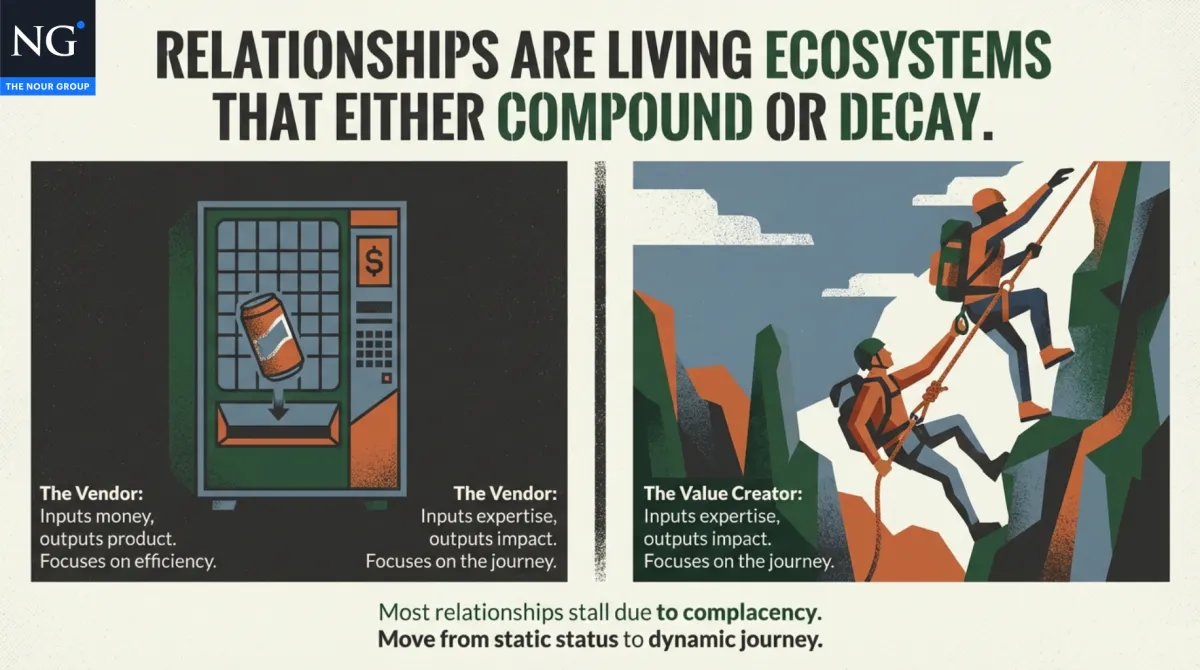
Most professional relationships don’t fail because of a lack of competence. They stall because of complacency. Over time, familiarity breeds efficiency—but not necessarily relevance. In Relationship Economics®, I’ve long argued that relationships are living ecosystems. They either compound exponentially and become more valuable over time or decay. They never stay static.
What separates those who merely maintain access from those who expand their impact is their ability to recognize—and act on—relationship inflection points. These are moments when uncertainty, change, or tension create a window to deepen trust, elevate relevance, and co-create new value.
Recent McKinsey research reinforces this idea: during periods of disruption, companies that proactively engage strategic partners outperform peers by as much as 30% in revenue growth over three years. The implication is clear. Relationship growth isn’t opportunistic—it’s intentional.
Below are some of the most consequential moments that can catalyze depth, health, and relevance in relationships, in essence, strategic growth, if you show up differently. Not louder. Not faster. Smarter.
Crisis Reveals Character—Institutional and Personal
A corporate crisis—an earnings miss, activist pressure, or a failed acquisition—forces leaders to reassess who is truly in their corner. Many professionals are replaced not because they caused the problem but because they failed to help frame the solution. This is where you either behave like a transactional vendor or step into the uncomfortable role of a strategic Co-Creator.
The same principle applies during personal crises. Leadership research from Harvard Business School shows that executives who feel personally supported by their strategic relationships are significantly more open to influence during periods of stress. This isn’t about intrusion. It’s about presence. Empathy, discretion, and perspective are currencies that are rarely forgotten. Think of that client who recently lost a parent, is going through a personal health crisis, or simply needs a sounding board for their personal aspirations.

Dissatisfaction Is Data—If You’re Willing to Listen Louder
Most dissatisfied clients don’t complain. They quietly disengage. When someone voices disappointment, they’re offering a gift—albeit a painful one to hear. How you respond determines whether trust erodes or compounds.
The most effective response is not excuse-making or problem-solving. It’s sense-making, addressing the root cause of what happened rather than merely addressing symptoms. Listen without defensiveness. Reflect their reality accurately. Jointly define what “better” looks like. Then rebuild trust incrementally. Relationship recovery, like financial recovery, compounds through disciplined small actions.
Healthy Disagreement Signals Respect
A difference of opinion is not a threat—it’s a relationship test. Can you challenge without alienating? Can you influence without posturing? Research from the Journal of Applied Psychology shows that leaders place greater trust in strategic relationships that demonstrate both intellectual rigor and emotional range during disagreements. A healthy dose of respectful pushback is good for every relationship!
Always agreeing signals insecurity. Always resisting signals ego. Strategic relationships navigate the tension between conviction and curiosity. They use data when facts matter, stories when meaning matters, and silence when space matters. Learn the difference and apply it consistently in how you show up.
New Executives Create Windows of Relevance
The first 90 days of a new executive’s tenure are the most fluid—and the most fragile. Decisions made during this window often shape trajectories for years. If you’re already in the organization, your institutional memory becomes invaluable. If you’re outside, your lack of legacy bias is your advantage.
This is not the time to sell products or services. It’s the time to offer context, ask better questions, and help them avoid predictable Curve Benders—those inflection points that either accelerate growth or trigger decline.
Environmental Disruption Demands an External Perspective
Deregulation, technological shifts, and geopolitical volatility—these moments overwhelm internal bandwidth. History is instructive here. Many category-defining companies emerged during the 2008–2009 recession because leaders leaned into external perspectives rather than retreating inward.
During disruptions, leaders don’t need more information. They need interpretation. They need strategic relationships that can connect the dots, frame trade-offs, and help them co-create strategic responses—not just react tactically. And ChatGPT can’t do that for them (yet!)
Reorganizations Reward Early Agenda Setters
Organizational or industry restructurings create both relational opportunity and risk. Those who help shape the agenda are rarely excluded from execution. Those who wait for the RFP are commoditized by design.
Agenda Setting is one of the most underutilized relationship growth strategies. It requires investing before budget certainty—bringing insights, scenarios, and implementation foresight when others are still pitching credentials.
Speaking Truth to Power Builds Uncommon Trust
A few moments elevate a relationship faster than saying “no” when everyone else says “yes.” Especially when it costs you revenue. Leaders remember who protected them from themselves.
In Co-Create, I wrote that trust is built not through alignment but through courageous contribution. Strategic relationships that are willing to challenge flawed assertions or assumptions earn disproportionate credibility and influence, not because they are contrarian, but because they are principled.
Competitive Market Disruption Creates Relational Openings
Incumbents often make arrogant mistakes. Key leaders leave. Teams change. These are not moments to pounce—they are moments to be prepared. Relationship optionality is built long before an opportunity arises.
That’s why consistent, low-friction engagement matters even when you’re not in the deal. Staying informed, staying relevant, and staying helpful keeps the door unlocked when others are scrambling to find the key.
Relationship Reciprocity, Investments, and the Power of “No”
Strategic relationships thrive on balance—not equality, but mutual value exchange. Sometimes that means explicitly addressing imbalance. Other times, it means investing in Relationship Currency® or Reputation Capital®: proprietary market research, executive peer briefings, or tailored learning experiences that create dialogue rather than dependency.
And sometimes, growth is catalyzed by letting go of deals you shouldn’t do. Referring a client to a competitor when it’s the right answer reinforces credibility far more than forced compliance ever could.
New Buyers, New Environments, New Energy
Relationship growth often requires stepping outside the familiar and comfortable. A new buyer. A different setting. A fresh team. Behavioral science consistently shows that changing environments increase openness and perceived intimacy. The same conversation in a different context often yields different outcomes.
Similarly, rotating or augmenting relationship teams can rekindle curiosity and relevance—especially when the client organization has evolved faster than your engagement model.
Think Like a Competitor—Then Act Like a Strategic Partner
One of the most effective client relationship audits is to ask: If I were trying to displace myself or our team, how would I do it? Where are you, your team, or your company vulnerable? Where are you overconfident? Where are you invisible?
This exercise rarely fails to surface glaring blind spots—and opportunities to reinforce value before a competitor exploits them.
From Trusted Advisor to Trusted Strategic Relationships
The highest form of relationship growth is a strategic partnership, not based on loyalty or tenure. A strategic partnership implies shared risk, shared learning, and shared outcomes. Long-term contracts, joint intellectual capital, employee exchanges, and co-branded thought leadership all signal a commitment beyond transactions.
Co-Created account planning—done with the client, not about the client—embeds this mindset. It reframes growth as a mutual endeavor rather than a revenue objective.

