Our Best Work Happens in Relationships
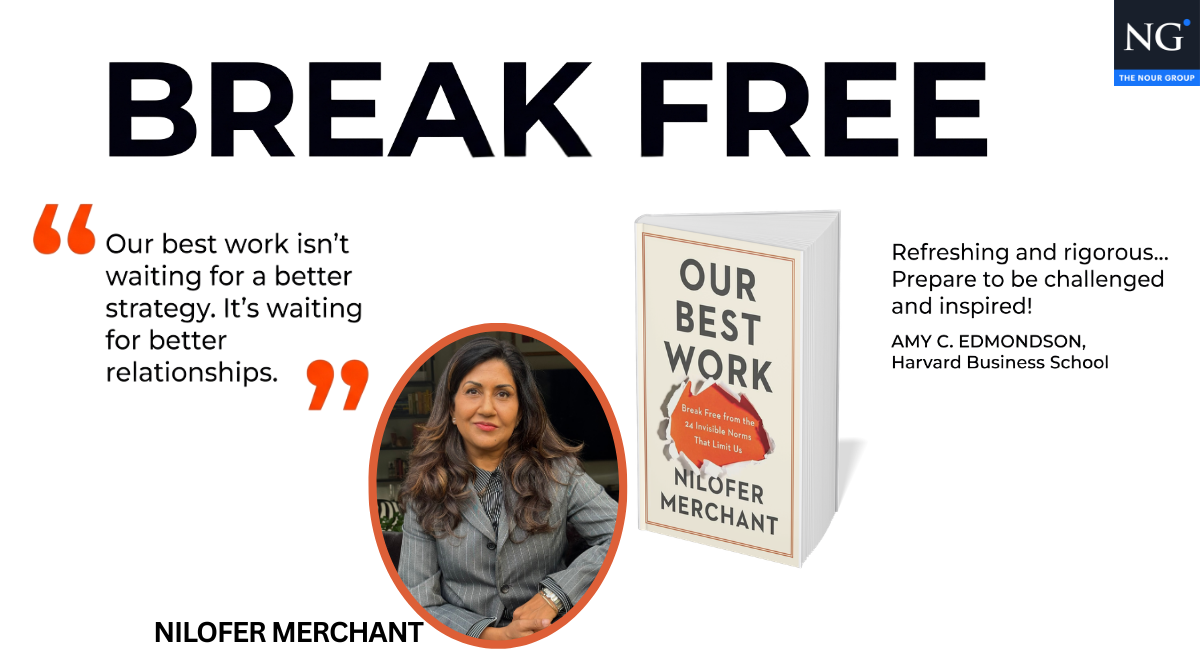
In Our Best Work, Thinkers50 friend Nilofer Merchant challenges something most executives rarely question: the invisible norms that shape how work actually happens. These norms aren’t written in policy manuals or annual reports. They show up in meetings, in who gets heard, in who gets promoted, in what gets measured, and in what gets quietly ignored. And they’re suffocating innovation.
Nilofer argues that only a small percentage of enterprise value today comes from tangible assets—buildings, patents, and capital equipment. The rest—often more than 80%—is intangible: ideas, trust, collaboration, networks, intellectual capital, and psychological safety. In other words, the real drivers of value are relational.
Yet most organizations are still managed like industrial factories.
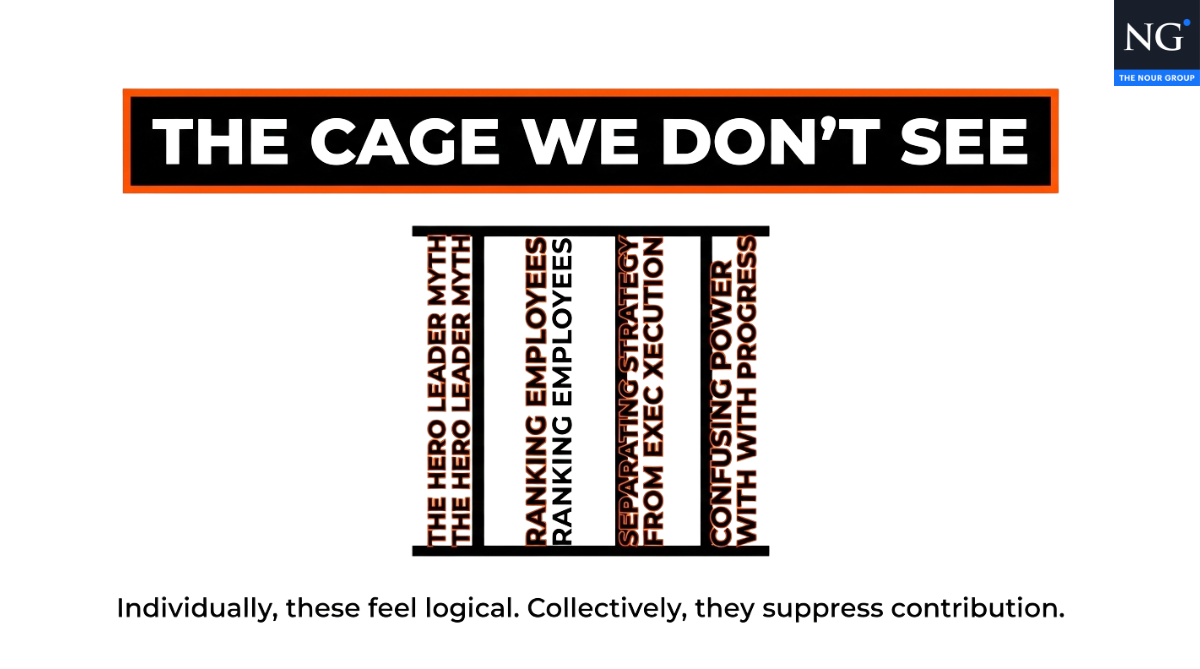
The Cage We Don’t See
A fascinating metaphor Nilofer introduces is a cage with invisible wires formed by inherited norms. If you look at any one wire, it doesn’t seem limiting. But taken together, they constrain behavior and ambition.
Consider a few familiar norms:
The hero leader myth
Ranking employees against each other
Separating strategy from execution
Confusing power with progress
Believing bigger automatically means better
Individually, these feel logical. Collectively, they suppress contribution.
This is where Our Best Work intersects with Relationship Economics®. Value creation has shifted from ownership to access, from hierarchy to networks, from capital accumulation to idea amplification, and from individual performance to collective intelligence.
If you still optimize for the lone genius or the “high-impact player,” you’re designing against how value is actually created. Nilofer’s insight is simple but profound: value is no longer capitalized. It is co-created.
Power vs. Purpose
One of the book’s sharpest contrasts is between power and purpose.
Power asks: How much can I control?
Purpose asks: What are we creating together?
Power counts size—headcount, revenue, territory.
Purpose measures significance—impact, meaning, shared progress.
In my work with global clients, I often see leaders trapped by power metrics. More clients. Greater revenues. Bigger teams and territories. Yet growth plateaus because relationships are transactional rather than strategic. Networks are wide but not deep. Contacts aren’t converted into economic buyers because relational capital is unmanaged.
Nilofer would argue that you’re measuring the wrong things. When we over-optimize for visible metrics—profit, productivity, and utilization—we underinvest in invisible drivers: trust density, idea exchange, cross-boundary collaboration, and psychological safety. Here’s the inconvenient truth: what we don’t measure, we don’t manage.
Strategy and Execution Are One
Another powerful norm Nilofer dismantles is the artificial separation of strategy and execution. In many firms, strategy is an off-site event, and execution is delegated. But when those responsible for delivery are disconnected from the thinking that shapes direction, relational breakdowns occur. Silos form. Buy-in evaporates. Innovation slows. Strategy isn’t a deck. It’s a conversation. Execution isn’t a checklist. It’s relational alignment.
This aligns directly with the Co-Create framework: strategy becomes powerful only when those who must execute it have co-authored it. Contribution drives commitment. If value is co-created, then strategy must be co-created. Otherwise, you’re just broadcasting intent.
Cultivating the Garden
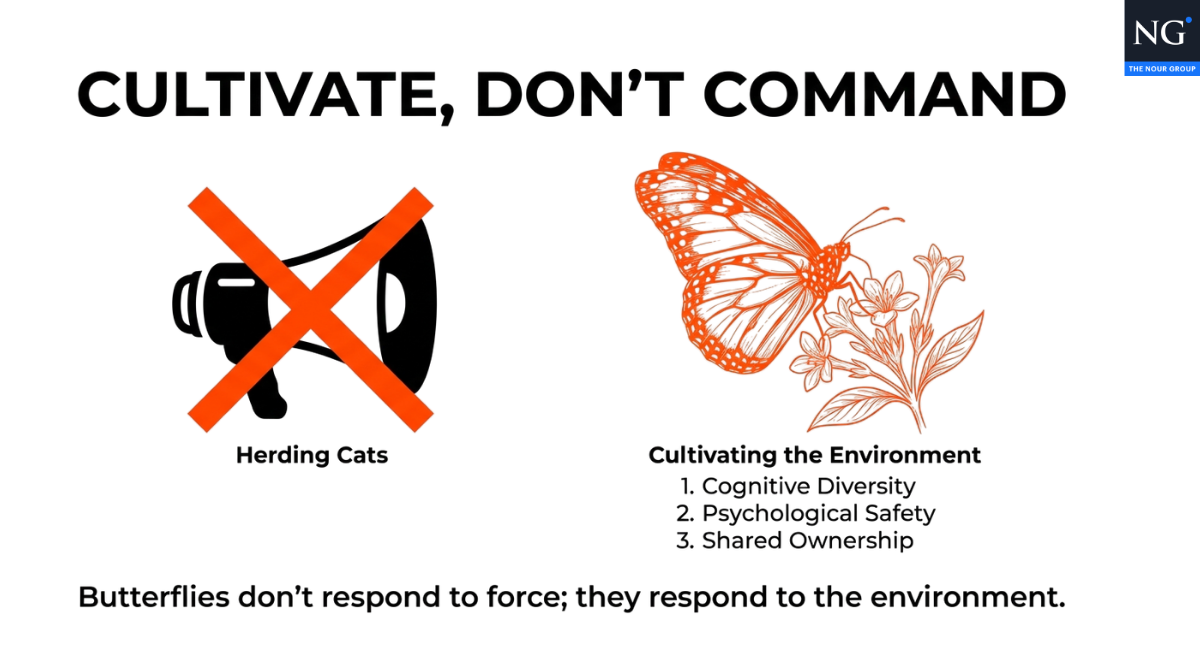
Nilofer offers another compelling metaphor: leadership is not herding cats; it’s cultivating butterflies. Butterflies don’t respond to force; they respond to the environment. If you want innovation, you don’t command it; you design for it.
That means:
Cognitive Diversity (not monoculture)
Psychological Safety (not fear-based performance)
Bi-Directional Conversations (not debate-as-battlefield)
Shared Ownership (not credit hoarding)
In Relationship Economics, leaders must architect relational conditions that enable value to flow. Intelligence, Nilofer argues, emerges through interaction—not in isolation. This explains why so many “high performers” struggle when moved to new environments. Talent isn’t portable in a vacuum. It’s contextual. It’s relational. A-teams outperform A-players because interdependence beats individual brilliance.
AI and the Intangible Future
The urgency of Nilofer’s thesis intensifies in the age of AI. Machines replicate routine. They scale processes. They optimize efficiency. But they cannot invent with moral judgment. They cannot dissent. They cannot sense relational tension. They cannot care. The more automation advances, the more uniquely human capabilities matter:
Synthesis
Trust-building
Dissent
Creativity
Collective sensemaking
In other words: relationships.
If organizations fail to recognize and measure intangible value creation, they risk designing systems that optimize for humans in irrelevant ways. The future of competitive advantage isn’t operational efficiency. It’s relational intelligence.
Where This Meets Curve Benders
In Curve Benders, I argue that nonlinear growth requires strategic relationships that alter the trajectory. Nilofer complements this by arguing that the internal conditions of work must enable those relationships to create value. You cannot bend the curve externally if your internal norms suffocate contribution. You cannot co-create externally if you dominate internally. You cannot scale trust in the market if you starve it within your culture. The invisible norms inside your firm shape the visible outcomes outside it.
So What Now?
If you’re in a leadership role, here’s the uncomfortable question: which invisible norms are caging your best work? Is it the hero narrative? The obsession with utilization rates? The separation of thinking and doing? The fear of dissent? The fixation on individual credit?
Nilofer’s gift is not just about identifying the cage—but about inviting us to redesign it. Because our best work is not an individual act. It’s relational. It’s co-created. And it emerges when leaders shift from control to cultivation.
The question isn’t whether you have talent. The question is whether your relational architecture enables that talent to contribute.
If you’re ready to rethink how relationships drive the creation of intangible value—and how modern firms must evolve beyond inherited norms—this book is essential reading. Our best work isn’t waiting for a better strategy. It’s waiting for better relationships.