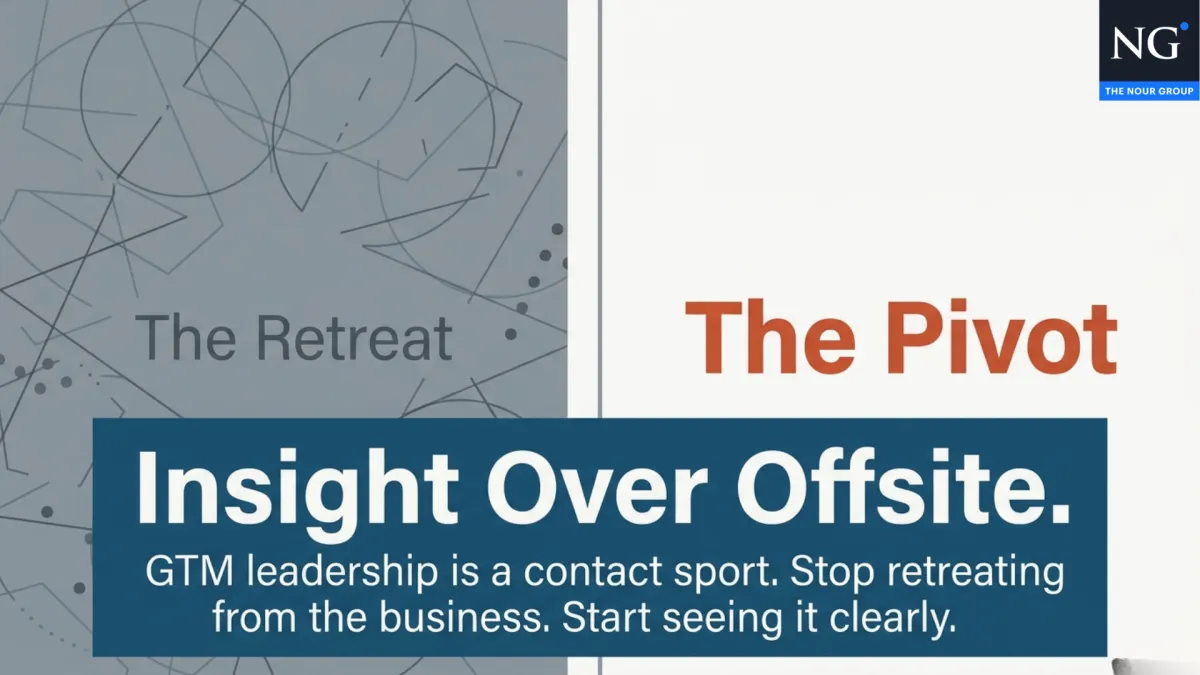
Your Mid-Year GTM "Insight," Not Offsite: Why World-Class Leaders Leverage Mid-Year to Think Differently
For years, go-to-market (GTM) leadership teams have invested in the familiar rhythm of the annual off-site. Book the retreat location, fly everyone in, build the agenda, review the numbers, run a few breakout sessions, add dinner and maybe a team-building activity, and send everyone home with a deck, a few commitments, and the faint hope that this time the follow-through will be different.
I am not against off-sites. In the right context, they can foster fabulous connections, much-needed alignment, and the momentum the team needs to achieve its stretch goals. Yet too often, the very word "offsite" implies that strategic thinking requires escape. We have to leave the office, clear the calendar, change the scenery, and step away from the day-to-day before we can think clearly about the business.
What if that assumption is wrong? What if the real opportunity is not an offsite, but an actionable insight?
A mid-year GTM Insight is not about where you go. It is about how deliberately you pause. It is not about retreating from the business. It is about seeing the business more clearly. For revenue, sales, marketing, customer success, partnerships, product marketing, RevOps, and enablement leaders, the midpoint of the fiscal year is one of the most underutilized strategic moments on the calendar.
By midyear, the story of the year has begun to take shape. The market has spoken, customers have behaved differently than expected, forecast assumptions have been tested, campaigns have either moved the needle or exposed noise, sales plays have gained traction or stalled, and customer success motions have protected value or surfaced risk. The leadership team now has enough evidence to stop guessing and start learning.
Yet too many teams simply keep running. They move from Q2 close to Q3 execution with no meaningful pause. They update the forecast, refresh the pipeline, reprioritize a few accounts, and push harder. The assumption is that the answer to mid-year pressure is more activity, including more outreach, more pipeline reviews, more dashboards, and more urgency.
But in my experience working with GTM leadership teams across growth companies, mid-market firms, enterprise organizations, and private equity-backed businesses, activity is rarely the constraint. Clarity, alignment, and honest conversations are! The capacity to think together, not just report to one another, often separates teams that finish the year strong from those that simply exhaust themselves trying.
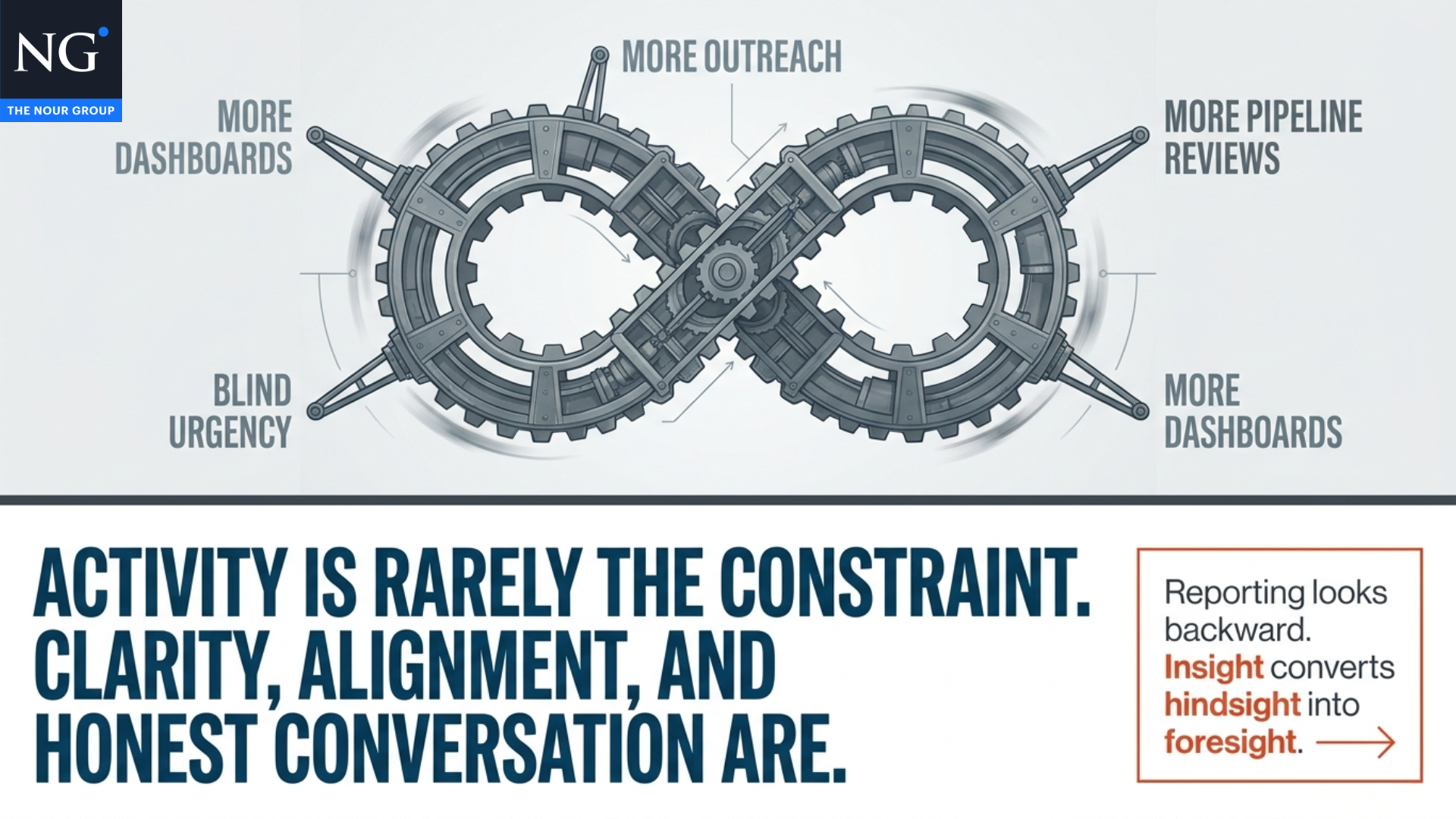
A mid-year GTM Insight creates space to ask a different set of questions. Not "What happened?" but "What did we learn?" Not "Who missed the number?" but "What signals are we ignoring?" Not "How do we make up the gap?" but "What must we do differently in the second half, given what the first half taught us we can no longer afford to overlook?" This distinction matters. Reporting looks backward. Insight converts hindsight into foresight.
Most GTM leadership meetings are optimized for updates, not learning. Each function brings its perspective. Sales talks about the pipeline. Marketing talks about demand. Customer success talks about retention and expansion. RevOps talks about conversion rates, velocity, and forecast accuracy. Product marketing talks about positioning and competitive dynamics. Enablement talks about adoption and execution. Each function has data and a narrative, yet the real value comes when the team connects those narratives into a shared understanding of the business. That rarely happens by accident.
Remote and hybrid teams make this even more important. In many GTM organizations today, leaders work across geographies, time zones, customer segments, and functional silos. They may meet often, but they do not always think deeply together. They exchange information, but seldom share best practices. They solve urgent problems, but rarely examine patterns. They collaborate on deals, launches, and escalations, but may not pause long enough to ask, "What are our best teams doing differently, and how do we scale that behavior?"
A well-designed GTM Insight changes that. It creates a forum where leaders can compare what is working, expose what is not, and surface the invisible practices that live within pockets of excellence. Your highest-performing regional leader may have discovered a better executive engagement motion. Your strongest customer success leader may have learned to identify expansion risk earlier. Your best field marketer may have found a more effective way to activate strategic partners. Your RevOps team may see friction points that no single function owns but that everyone experiences.
Without an intentional forum, those insights stay local. With one, they become institutional knowledge. The timing is also ideal. Midyear is late enough to have meaningful evidence and early enough to act. At the beginning of the year, every plan sounds plausible, every assumption pristine, and every model achievable. By year-end, the story is often over: you are either celebrating, explaining, or apologizing. But halfway through the year, you still have agency; you can adjust, redeploy, and simplify. You can stop what is not working and double down on what is. That is adaptive leadership.
The best GTM Insight sessions I have seen avoid becoming performative strategy theater. They are not elaborate presentations followed by polite nodding. They are courageous conversations grounded in evidence, reflection, and decision-making. They ask: Where are we winning, and why? Where are we losing, and why? Which January assumptions have proven false? Which customer segments are more resilient than expected? Which buying committees are slowing us down? Where are we overinvesting? Where are we underleveraging relationships? What must be true for us to finish the fiscal year strong?
These questions are not always comfortable. They should not be. Comfort rarely produces insight. But discomfort without trust breeds defensiveness. That is why psychological safety is essential. GTM leaders need room to say, "We were wrong." "We missed the signal." "We are seeing friction between functions." "Our handoffs are not working." "The field is confused." "The message is not landing." "We are creating activity without enough impact." These statements are not admissions of failure. They are invitations to lead.
This is where a skilled moderator can be invaluable. The right agenda setter is not there to dominate the conversation or deliver generic frameworks. Their role is to create the conditions for candor, draw out quieter voices, challenge lazy assumptions, synthesize patterns, and keep the group focused on decisions rather than drifting. They can help leaders engage in healthy, respectful debate without turning disagreement into politics. They can ask the question others are thinking but not saying. They can prevent the loudest voice or the highest title from owning the room.
Most importantly, a seasoned moderator with lived experience working with global GTM teams can help the team turn conversation into commitments. Insight without action is simply a more thoughtful form of inertia.
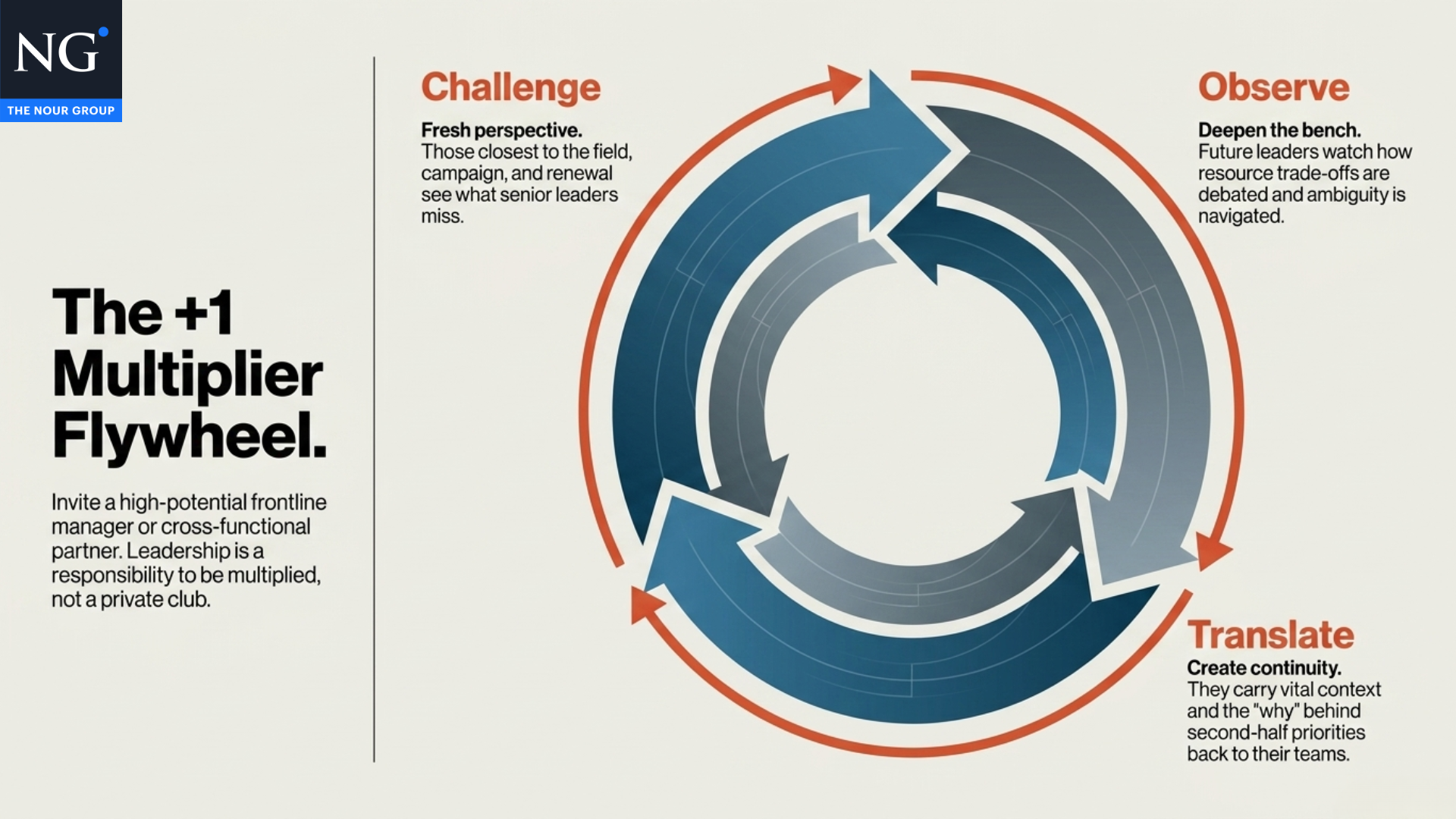
One of the most powerful practices I recommend is for every GTM leader to bring a "+1" to the mid-year Insight. Not a guest for optics or a passive observer, but a high-potential leader, emerging operator, frontline manager, or cross-functional partner who would benefit from exposure to conversations they are rarely invited to. This one move changes the dynamic in profound ways.
First, it deepens the leadership bench. Future leaders do not become strategic by reading finalized strategy documents. They become strategic by hearing how trade-offs are debated, how assumptions are challenged, how resource-allocation decisions are made, and how leaders navigate ambiguity.
Second, it creates continuity. When those +1 leaders return to their teams, they carry context, not just instructions. They understand the "why" behind second-half priorities.
Third, it offers a fresh perspective. People closer to the field, the customer, the campaign, the renewal, or the partner motion often see what senior leaders miss.
Over two decades as a student of business relationships, I've both seen and led these mid-year GTM leadership Insight sessions as a strategic relationship-development opportunity within the business. You are strengthening ties across functions, expanding trust, increasing contextual intelligence, and creating shared ownership of the second half. The +1 is not merely being developed. They are being connected to the enterprise conversation. That matters.
Too many organizations talk about developing future leaders while keeping them outside the rooms where leadership actually happens. A GTM Insight offers a practical way to change that. It allows emerging leaders to observe the difference between managing a function and leading an enterprise. It also signals that leadership is not a private club. It is a responsibility to be modeled, shared, and multiplied.
The output of a mid-year GTM Insight should not be a bloated strategy document. It should be a clear set of second-half leadership decisions. What will we stop doing? What will we start doing? What will we simplify? What will we scale? What will we inspect more rigorously? Which relationships must we activate? Which customer signals must we listen to more carefully? Which cross-functional dependencies must we repair? Which few moves will matter most between now and the end of the fiscal year?
The best teams leave with fewer priorities, sharper language, stronger trust, and a more candid view of what the business needs from them. They leave not with generic alignment, but with earned alignment, the kind that comes from debate, evidence, and shared ownership.
No, you may not need another offsite. You may not need flights, hotel rooms, or a mountain lodge. You may need something more valuable: time to think, space to challenge, permission to learn, and the discipline to lead the second half differently. That is the promise of a GTM Insight.
At midyear, the question is not whether your team can work harder. Most teams already are. The better question is whether your leaders can think more clearly, learn more honestly, and act more intentionally. The first half gave you data. The second half will show whether you turned it into wisdom. In a market that rewards focus, trust, speed, and adaptability, that may be the difference between explaining the year and finishing it strong.
And no, Claude can't do this for you. GTM Leadership is a contact sport that requires you to get in the arena!
